It’s one of the highest visibility positions in the country and yet it has no job description. So, it has been left to America’s first ladies to decide for themselves how they should fill their important but constitutionally undefined role.
For more than 235 years, they’ve done just that, according to Keuka College Professor of History Dr. Christopher Leahy and his wife, independent scholar Sharon Williams Leahy. The couple examined the role and responsibilities of first ladies, with special emphasis on Julia Gardiner Tyler, the topic of their new biography, Presidentess: The Life of First Lady Julia Gardiner Tyler.
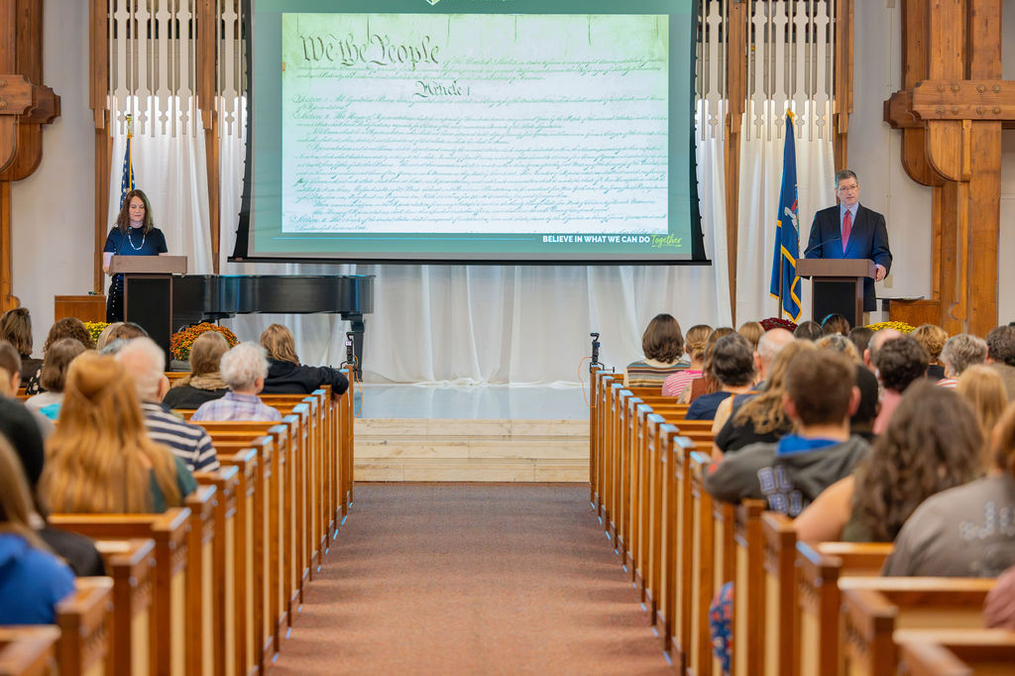
The couple spoke before an audience of more than 150 students, faculty, administrators, and community members in Norton Chapel on Thursday, Sept. 17, in commemoration of Constitution Day, which marks the anniversary of the Constitution’s signing in 1787. That document outlines executive authority in exquisite detail but says nothing about duties and expectations surrounding presidential spouses.

“So, if the Constitution did not create the role of the first lady, who did? The answer is deceptively simple: The women themselves did, through precedent, innovation, personality, and public expectation.”
That process began with Martha Washington, said Sharon Leahy.
“She helped shape the republican style of the presidential social events, and she did that through being formal enough to represent the new national government while carefully making sure that it was a little different from European royal court,” said Sharon Leahy. “In her receptions and the public role, she established precedents for all those that followed her.”
Subsequent first ladies expanded and revised the role, the Leahys explained. Abigail Adams – the first first lady to live in the White House – established the idea of presidential spouse as political advisor. Dolley Madison solidified White House functions as important social and political events (and helped save the famous Gilbert Stewart portrait of George Washington from destruction at the hands of invading British forces during the war of 1812).
Despite living in the White House for only eight months, Julia Gardiner Tyler left a deep imprint on the role. President John Tyler’s second wife – the result of the first and only presidential elopement – the 23-year-old Long Island native immediately became the center of Washington society. Well-educated, cultured, and the beneficiary of a year-long tour of Europe, she was well prepared for the role she assumed in June 1844.
She forged four areas of influence, said Dr. Leahy:
-
Presidential ceremonies, taking advantage of receptions, events, and diplomatic encounters.
-
Proximity and access to the president, which allowed her to offer advice, make recommendations, or intercede on other people’s behalf.
-
Effective use of the press to shape public opinion.
-
The active shaping of her legacy after leaving the White House.
“It’s important to point out that influence is not the same thing as authority,” said Dr. Leahy, “but it is nonetheless significant.”
With influence, however, comes the potential for criticism.
The Leahys describe a 19th-century political cartoon that depicted Julia Gardiner as the reason President Tyler abandoned his bid for reelection. It was “the first time the first lady was linked directly to a presidential campaign,” Dr. Leahy said.
The Leahys went on to discuss how 20th-century first ladies continued to mold and reimagine their duties.
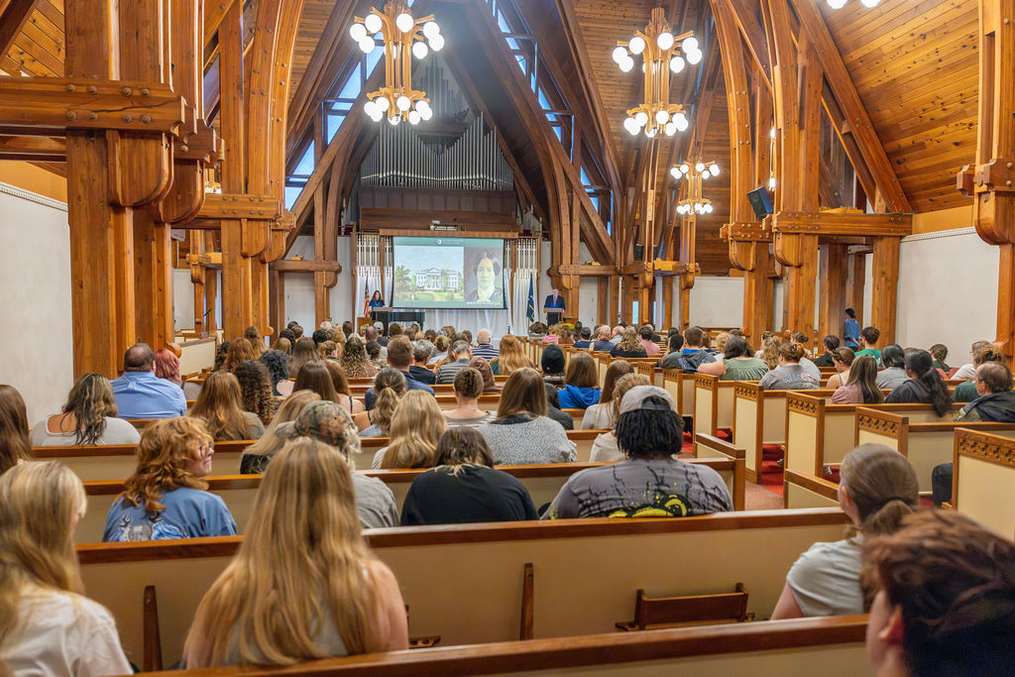
Students, faculty, staff, and community members filled the pews in Norton Chapel for Keuka College's Constitution Day presentation. About a dozen took part in a post-presentation question-and-answer session.
Eleanor Roosevelt expanded the public possibilities of the role through her advocacy, press conferences, syndicated newspaper column, and widespread travel (which included a visit to Keuka College).
Mamie Eisenhower – a particular focus of Sharon Leahy’s scholarly work – commanded the domestic and social sphere of the White House, served as a sounding board for the president’s speeches, and developed an enormous direct communication network with the public.

“She used her celebrity and visibility strategically, forming partnerships with women in fashion, design, manufacturing, and the arts. Those relationships had real economic and cultural consequences.”
Lady Bird Johnson focused on advocacy that built largely on what others had done before her and developed a public agenda around conservation and beautification.
Today, first ladies oversee staffs that include communications and press personnel, schedulers, policy advisors, speechwriters, and other functionaries. What they do not have – still – is constitutional direction.
“Over more than two centuries, the women who occupied that undefined position create the role themselves through precedent, personality, public expectations, and informal influence,” said Dr. Leahy. “Julia Gardiner Tyler makes that evolution especially visible.”
The presentation was recorded for broadcast by C-SPAN.